The Anti-AI Psyop
AI does not create the culture it learns from. It is an extraordinary template engine that needs human work, judgment and taste. The people selling it benefit when that tool is confused with the people and institutions choosing how to use it.
People hate AI and cannot articulate why.
Ask one person and AI is going to kill everyone. Ask another and it is going to take everyone's job. Ask an artist and it stole the work. Ask a town getting a data center and it is the power bill and the water. Ask somebody else and it is fake pictures, surveillance or a chatbot that takes your job.
Those are not one problem.
But the sentiment is the same:
AI is bad.
It is the biggest psyop in technology right now.
I do not mean Sam Altman, Dario Amodei, Elon Musk, Eliezer Yudkowsky and every angry illustrator met in a room and planned it. They do not have to. Different people can follow different incentives and still produce the same story.
The extinction people need AI to sound like a bomb. The AI companies need it to sound powerful enough to replace labor and dangerous enough to regulate. Investors need it to sound inevitable. Social media needs everyone scared enough to keep arguing. Then the public hears the same message from every direction: this machine is coming for you.
The result is real. In 2025, 51% of Americans told Pew they were more concerned than excited about AI, against 11% who were more excited. Fifty-six percent were highly concerned about job loss. In 2026, 79% told Gallup that AI would reduce the number of jobs in the United States (Pew Research Center; Gallup).
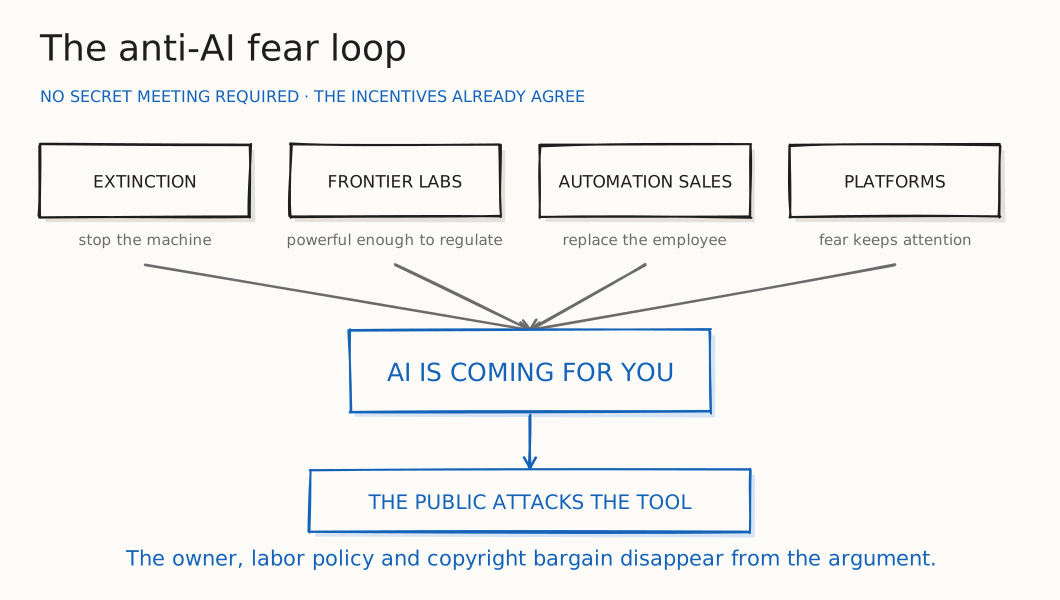
People are not imagining the pressure. They are being handed the wrong unit of analysis.
AI is a tool. More precisely, it is a very good template engine. The company, the labor policy, the copyright deal, the data center and the person using it are different things.
Hating all of them at once makes the owners disappear.
The people who actually think AI will kill us
The first group means exactly what it says.
Eliezer Yudkowsky spent years building the AI-risk argument around LessWrong and the Machine Intelligence Research Institute. In 2023 he did not ask for careful product rules. He asked governments to stop large training runs, track GPU sales and be willing to destroy a rogue data center by airstrike. His position was that continuing could kill everybody (Yudkowsky, “Shut it all down”).
Nick Bostrom's argument is more academic, but it ends at the same risk. A machine smarter than its makers could acquire capabilities faster than humans can control it, and the downside includes extinction (Bostrom, Superintelligence; “Existential Risks”).
I disagree with the certainty around that story. But I take the people making it seriously. This is not a branding trick for them. They believe the thing is dangerous and should not be built.
Geoffrey Hinton belongs closer to this group than to a company selling regulation. He signed the Center for AI Safety statement saying extinction risk should be treated like pandemics and nuclear war. So did Yoshua Bengio. They are researchers making a risk claim, not CEOs asking the government to protect a product they sell (Center for AI Safety statement).
That distinction matters because the next group signed the same statement while building the systems.
The people building it want to write the rules
Sam Altman and Dario Amodei both signed the extinction statement.
OpenAI kept building. Anthropic kept building. Both companies also asked governments to create rules for the most capable models.

Logo: OpenAI via Wikimedia Commons.
.svg)
OpenAI proposed something like the International Atomic Energy Agency for superintelligence: an authority that could inspect systems, require audits and restrict deployment above a capability or compute threshold. To its credit, the proposal says smaller companies and open-source projects below that threshold should not carry the same burden (OpenAI, “Governance of superintelligence”).
Anthropic's proposal says government should be able to block models that pose a significant catastrophic risk and fine companies according to global revenue. Dario Amodei described future levels where a model could enable catastrophic biological misuse or escape human control (Anthropic policy; Amodei's AI Safety Summit remarks).
Maybe they believe every word. I have no evidence that either man is pretending.
That does not remove the incentive.
A frontier lab says the product it is racing to build may be as dangerous as a nuclear weapon. It then asks to help define which models are dangerous, which tests count and which companies may keep building them.
Being first to market is useful. Being first to the law is better.
A large incumbent can pay for licenses, audits, lawyers, security teams and government relations. A person training a model in a garage cannot. The regulation can be neutral on paper and still turn the first company's lead into a wall.
This is not a new concern invented by AI critics. The American, British and European competition agencies warned together that control of chips, compute, data and expertise could let a few firms deepen their moats and shape AI to their own advantage. The FTC separately warned that cloud incumbents can use control of necessary inputs to entrench themselves (joint competition statement; FTC on generative-AI competition).
Google is the obvious history lesson. A federal court found that Google maintained monopolies in search through exclusive distribution agreements. The remedy later barred those exclusive contracts and required access to parts of Google's search index and interaction data for rivals (US Department of Justice).
The index matters. Once the open web becomes harder to crawl, the company that already indexed it starts with an asset the newcomer cannot reproduce. In 2025 Cloudflare changed its default to block AI crawlers for new domains unless the owner allowed them, and described publishers demanding payment or control over access (Cloudflare). Creators should have that control. It also means the next search or model company enters a web that is closing after the incumbent already read it.
That is how a moat works. A rule can solve a real problem and protect the company already across the line.
The fear does not have to be false to be useful to the person selling it.
Automation is the easier product to sell
The second part of the psyop is simpler.
AI companies need nontechnical executives to buy AI. “This tool will help your staff think” is hard to put in a valuation model. “This tool will let you employ fewer people” fits in one spreadsheet cell.
So the pitch becomes automation.
This is one of the oldest splits in computing.
The 1955 Dartmouth proposal that named artificial intelligence started with the belief that every feature of intelligence could be described precisely enough for a machine to simulate it (McCarthy, Minsky, Rochester and Shannon).
Douglas Engelbart asked a different question. In 1962 he defined augmenting human intellect as increasing a person's ability to understand a complex problem and solve it. The computer was part of a system around the person, not a replacement waiting for the person to leave (Engelbart, Augmenting Human Intellect).
The market keeps presenting McCarthy's side as the destination and Engelbart's side as a temporary step.
But the actual use has never been that clean. Anthropic's first Economic Index found 57% of Claude use looked like augmentation and 43% like automation. People were learning, checking work and iterating with the model more often than they were handing it a task and leaving (Anthropic Economic Index). Later data showed much more automation through business APIs than through the consumer chat product. The same model becomes a collaborator or a replacement according to how its owner installs it (Anthropic, AI's role in the economy).
That is the part missing from the sales pitch.
The model does not walk into a company and fire anybody. A manager decides to use it that way.
Suno is a perfect symbol for the confusion. A prompt becomes a finished song, so the product is discussed as a replacement for musicians. But a musician can use the same kind of model to sketch an arrangement, make a sample, separate a stem or try an idea without renting a studio. One story is automation. The other is augmentation. The software can do both.
Only one story makes the demo look like an entire labor force disappeared.
AI can't replace human ingenuity
This is the central part for me.
AI cannot make something from nowhere. It needs people first.
A language model is trained by predicting the next piece of text in a huge collection of human writing. Image and music models learn a similar statistical problem over different kinds of data. OpenAI describes its own base model plainly: it learns relationships in the training data and generates by predicting what comes next (OpenAI, how its models are developed; GPT-4).
That can produce an image, sentence or song that has never existed byte for byte. So saying a model can produce nothing novel is too easy to knock down. A shuffled deck can produce an order nobody has seen before too.
That is not the kind of new I mean.
The model does not decide what deserves to exist. It does not have a childhood, a body, a neighborhood, an enemy, a rent payment, an audience or a reason to offend the old taste. It did not invent the culture in its training set. It received one.
Then it learned the reusable shape.
That is why I call it templating. Not because the output is a copy-and-paste, but because the machine is extraordinary at extracting a pattern people already made and producing another valid thing inside it.
A model can write another detective scene after reading millions of scenes. It cannot make human beings care about detective fiction in the first place. It can generate a new drum pattern inside the music it learned. It cannot live in the city that produces the next sound, gather the people around it and make the old sound feel dead.
Humans create the market. The model learns the market.
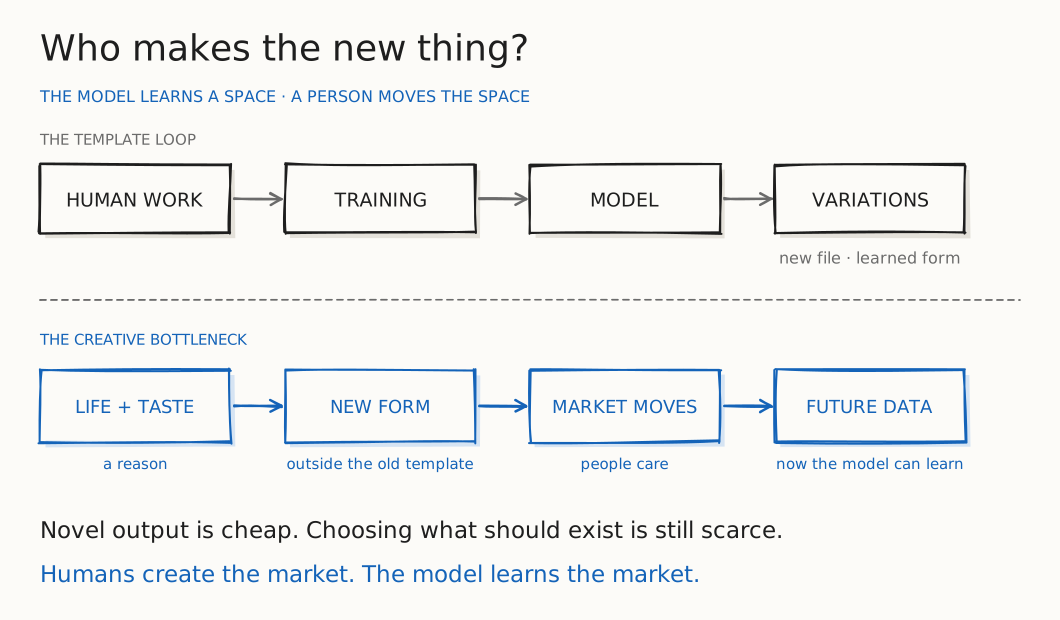
This is why the most creative person is not positioned like the average producer of content. If your value is making another acceptable thing in an established form, AI puts pressure on the price. That is exactly what a template engine is good at.
If your value is deciding what the next form is, the model needs you. You are upstream of its training set.
That does not mean every creative keeps a job. Companies can flood a market with cheap templates and destroy the income before the next culture has time to form. A musician can be economically displaced even when the machine never becomes a musician. Price and creativity are not the same account.
But it changes the strategy. Trying to beat the template engine at making templates is a bad position. Moving the taste, owning the audience and making the work that becomes tomorrow's training category is the bottleneck.
Why that fits China
I remembered Travis Kalanick describing China as the hardest market because it was a replication machine. I could not verify that exact sentence, so I am not going to turn my memory into his quote.
What I could verify is the account. In a letter to investors, Kalanick said a Chinese competitor had cloned Uber's core product line. Uber later said it was losing more than $1 billion a year in China while Didi bought market share, and Uber eventually sold its Chinese operation to Didi (Kalanick's investor letter; Uber's reported China loss).
The lazy conclusion is “China copies.” That is not my point, and it is obviously false as a description of a country that also produces original science, products and culture.
The useful conclusion is that China's industrial system is exceptionally practiced at taking a working form, localizing it, iterating it, manufacturing it and scaling it under brutal competition. Replication is not the absence of skill there. Replication at that speed is the skill.
AI fits that system. A trained model captures a working form and makes variations cheap. The human and industrial system around it tests the variations, keeps what works and spreads it. China's own AI plan emphasizes putting AI into manufacturing, health care, education, agriculture and other industries, while sharing infrastructure and lowering technical barriers (China's Global AI Governance Action Plan).
That is a better fit than the American pitch where one magic model replaces the company.
The strength is not that AI becomes creative. The strength is that a society already good at turning one useful pattern into a million useful instances gets a better pattern machine.
Artists are angry at the wrong layer
Not wrong about the harm. Wrong about the layer.
Artists and writers have a real complaint about work being copied into training sets without a clear bargain. The US Copyright Office needed an entire report to separate fair use, licensing, market harm and liability, and did not reduce the answer to “the machine learned like a person” (US Copyright Office, generative-AI training report). Publishers are now blocking crawlers because the old exchange—content in return for search traffic—does not work the same way when an answer engine keeps the reader.
That fight is about consent, compensation and bargaining power.
It is not about matrix multiplication.
A model is a file of numbers learned from data. It has no labor policy. It does not own Spotify, YouTube, Adobe or the label. It does not choose the royalty split, charge the subscription, hide the distribution or decide who gets to train on whose work. Companies and governments do that.

Logo: Spotify via Simple Icons.
The creative economy was already full of platforms taking the distribution and renting the tool back to the creator. Generative AI can make that much worse if the same platforms own the models. It can also let one person make a tool that used to require an Adobe subscription, automate one ugly part of a Premiere workflow or build a music pipeline around open software.
No, one prompt does not rebuild all of Photoshop, Ableton or DaVinci Resolve. That is the same automation fantasy in reverse.
But a person no longer has to accept the whole bundle to change one part of the workflow. A small model, some code and a local computer can replace the slice they actually needed. They can own that piece. They can even own the way it reaches the audience.
That is Engelbart's AI: not a fake employee, but a machine that gives one person capabilities previously rented from an institution.
AI is communist
Peter Thiel gave the argument a label in 2018. “Crypto is decentralizing, AI is centralizing,” he said. “Or, if you want to frame it more ideologically, crypto is libertarian and AI is communist” (Axios, “Peter Thiel: AI is communist”).
That is a good description of one AI system: everybody's data flows into one center, one institution owns the computers and the same institution watches the population.
It is not a property of the math.
A model running on my computer is not centralized because Peter Thiel called the category communist. A public model in a library is not the same political object as a private model scoring workers for dismissal. The weights can be identical. The ownership is not.
The Elon Musk story makes the same point, but there are two versions of it.
In the documented 2012 exchange, Demis Hassabis told Musk that colonizing Mars would not save humanity if a rogue AI could follow it there and destroy it. Musk went quiet, invested in DeepMind to watch the technology, and later helped found OpenAI as an open counterweight after Google bought DeepMind. Musk said the aim was something like a Linux version of AI that no single corporation controlled (Walter Isaacson in Time; Keach Hagey in Wired).
Then Peter Thiel gave the story its politics. In a 2025 interview, Thiel said Musk had come to believe that “the socialist US government, the woke AI” would follow him to Mars. Thiel connected that fear to Musk's rightward turn and support for Trump. That is Thiel's later interpretation, not something Hassabis said in the original exchange (Interesting Times with Ross Douthat; interview transcript).
Think about what happened. Fear of a machine following a billionaire to Mars helped produce a laboratory whose original answer was openness. That laboratory became a closed frontier company. Musk left, tried to put it under Tesla, and built another AI company. Then the story became fear that even escape from Earth would not escape liberal politics.
Why let him choose both sides?
China's official position uses different language. Its Global AI Governance Action Plan calls AI an international public good, asks for open sharing, wider infrastructure and fewer technical barriers, while also insisting on state control, safety and national sovereignty (China's Ministry of Foreign Affairs). A government statement is not proof that every Chinese system distributes power. It proves that one technology can be described as public infrastructure and state control in the same document.
AI is a means of production.
Capital can own it, hide it behind an API and use it to remove labor. Workers can use it to make themselves more capable. A cooperative can own it. A school can teach it. A library can provide it. A government can make compute a public utility. The same tool can concentrate productive power or distribute it.
The politics lives in the ownership.
So ask the socialist question.
Who owns the model? Who owns the computer? Who owns the training data? Who gets the productivity? Can the worker use the tool, or only be measured by it? Can the artist run it locally? Can a community build without an API bill or permission from a platform?
Those are political questions. “AI good” and “AI bad” are advertisements.
Data centers are not one thing either
The environmental argument gets compressed the same way.
Data centers use real electricity, water, land and grid capacity. In 2024 they used about 415 terawatt-hours of electricity worldwide, around 1.5% of the total. The International Energy Agency expects the number to rise. It also expects renewables to meet nearly half of the growth in data-center electricity demand through 2030, with gas, coal and nuclear supplying the rest (IEA, Energy and AI; energy supply for AI).
So “data centers are clean” is false. “Data centers must be dirty” is false too.
A data center connected to a coal-heavy grid, using drinking water for cooling while the owner receives tax breaks, is one political choice. A center built beside new clean power, with closed-loop or water-free cooling and public capacity on the machines, is another.
The United States already has a small version of public compute. The National AI Research Resource gives researchers and educators access to government, university and donated industry systems. It is limited and application based, but it proves shared national AI infrastructure is not imaginary (National Science Foundation).
I would go much farther. If public money pays for grids, land, tax incentives and research, the public should own compute on the other side. Libraries gave people books without requiring everybody to own a printing press. Public AI infrastructure can give people models and GPU time without requiring everybody to work for Microsoft.
The problem is not that a computer building exists. The problem is who gets the electricity, who pays for the line and who owns the output.
The actual psyop is surrender
The harms are real: displacement, surveillance, impersonation, copied work, concentrated compute and an industrial appetite for power.
The psyop is convincing people that those are natural properties of AI instead of choices made by its owners.
Then the trick goes one step further. Creative people are told the template engine is more creative than they are. Workers are told automation is inevitable. Socialists are told refusing the machine is resistance.
It is not resistance if the boss keeps the machine.
If workers refuse AI while management learns it, management owns the productivity. If artists refuse models while Adobe, Spotify, YouTube and the labels own the models and distribution, the platforms keep the leverage. If the public refuses data centers while private companies receive the grid connection and tax break, the public pays for infrastructure it cannot use.
Capital would love that arrangement. It gets the machine and its critics remove themselves from the market.
The socialist answer is not to pretend technology stops. It is to socialize the productive power:
- public compute, available like a library;
- local models that do not report every action to a company;
- open weights, open tools and the right to repair the workflow;
- unions bargaining over deployment, staffing and who receives the productivity gain;
- payment, control and collective licensing for people whose work becomes training data;
- clean power, water limits and public capacity attached to every data-center subsidy;
- interoperability so the model company cannot also own the cloud, the workplace and the route to the audience.
This is techno-optimism with a class analysis.
The techno-optimist part says productive power can make ordinary people more capable. The socialist part asks who owns that power, who decides how it is used and who gets the time it saves. One without the other becomes either a venture-capital advertisement or a politics of permanent scarcity.
AI is especially useful here because the expensive thing it learns can be reproduced much more cheaply than the human institution it came from. Compute is still scarce. Training is still expensive. But once a capable model can run locally, one person can reuse that capability across thousands of tasks without paying a specialist platform for every old workflow.
That should be a left-wing opportunity.
The creative does not disappear. The person with taste becomes more important because templated output becomes cheap. The worker does not become obsolete. The worker with access to the machine can do work that once required an entire department. The public does not have to beg the frontier lab. It can own computers and models of its own.
I believe in Engelbart's side. The computer should make the person more capable. If it only makes the institution more capable of removing the person, the failure is not intelligence. It is ownership.
So if you are on the left and hate AI, ask who gave you the frame.
Do you really agree with Peter Thiel that AI belongs to centralized control?
Do you want Elon Musk's apocalypse story to decide which tools ordinary people may use?
Or did the people selling automation convince you that their version of the future is the only version available?
It is not.
AI is not the worker. It is not the boss. It is the machine.
Stop surrendering the machine to the boss.