The Real Winners of the AI Wars
Everyone is watching the model companies fight. I followed the money backward instead. The winner is whoever owns the required part that nobody else can make fast enough.
Everyone is watching the wrong war.
OpenAI against Anthropic. Gemini against ChatGPT. Grok against everyone. Then OpenRouter, agents, wrappers, SaaS products and whatever launched while I was writing this sentence.
Cool. But who gets paid no matter which one wins?
OpenAI can beat Anthropic and NVIDIA still gets paid. Anthropic can beat OpenAI and NVIDIA still gets paid. Google can replace an NVIDIA GPU with a chip of its own and somebody still has to manufacture the chip.
So the question is not:
Who has the best AI?
The question is:
Who owns the thing every AI company has to buy?
I followed the money backward.
If GPUs are money, who prints the money?
An AI answer looks like software. It is not. It is electricity turned into sums by a physical machine.
The model needs accelerators. The accelerators need high-bandwidth memory. Thousands of them need a network. The processor and memory have to be joined in an advanced package. The processor has to be fabricated on a silicon wafer. The smallest parts on the wafer are printed by a lithography machine. Then the finished computers need a building, cooling and enough electricity to turn on.
The chain looks like this:
ASML -> TSMC -> HBM -> NVIDIA, AMD or a custom chip -> network -> data center -> model -> application
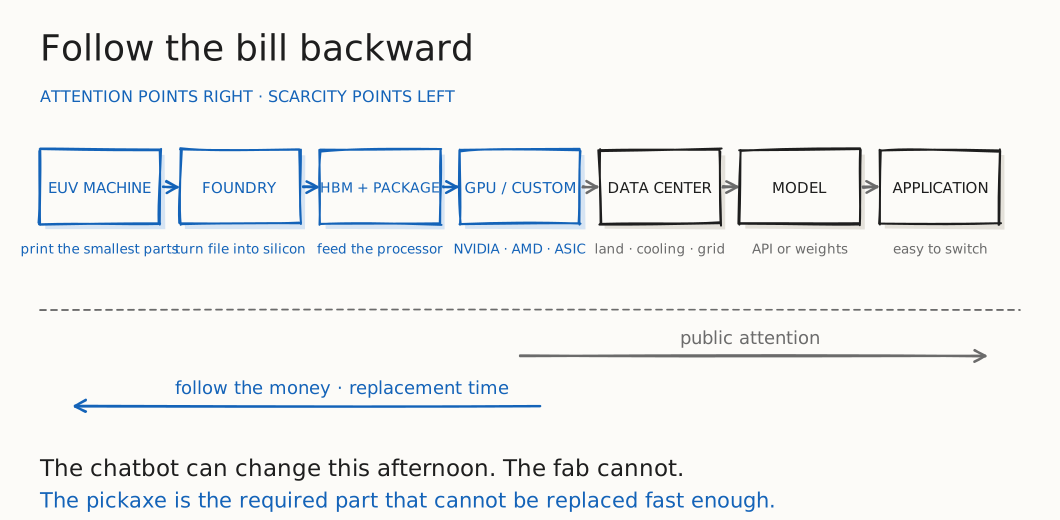
Most people stare at the right side because that is the part talking to them.
The scarcity is on the left.
A person can change chatbots this afternoon. A company can point an API at another model this week. Nobody downloads a leading-edge fab over the weekend. Nobody writes an EUV machine in Python because the old one got expensive.
At every layer I asked one question:
If this supplier says no, how long does it take the customer to replace it?
That is the pickaxe.
Jensen Huang is the new shadow king
He is selling the hardware to build AI.

Logo: NVIDIA via Simple Icons.
OpenAI needs compute. Anthropic needs compute. xAI needs compute. Meta needs compute. Microsoft, Amazon and Google need compute for their own models and for the people renting their clouds.
They are fighting each other with equipment bought from the same place.
In NVIDIA's fiscal year ending January 2026, the company made $215.9 billion in revenue. Data centers supplied $193.7 billion of it, 90%. Networking inside those data centers supplied $31.4 billion. In the quarter ending July 2026, data-center revenue reached $89.0 billion, 117% more than a year before. Gross margin was 75% (NVIDIA 2026 Form 10-K; NVIDIA, second quarter fiscal 2027).
Read the first pair again. $215.9 billion for the company. $193.7 billion from data centers.
That does not mean the buyers will make their money back. It means NVIDIA got paid while they tried.
And NVIDIA sells more than a GPU. It sells the links between GPUs, the rack around them and the software path programmers already know. A competing chip does not only have to do the sums. It has to replace enough of that path to make moving worth it.
This is why NVIDIA is the clearest winner right now. It does not have to know which chatbot wins. It supplies several of them.
But NVIDIA does not make the physical chip.
Who makes the pickaxe?
NVIDIA's own annual report gives the answer. TSMC and Samsung make its wafers. SK hynix, Micron and Samsung supply the memory. TSMC's CoWoS joins processors and memory into advanced packages. Other companies assemble and test the finished products (NVIDIA 2026 Form 10-K).
NVIDIA sells the pickaxe. It buys the metal.
TSMC
A chip design is a file until a foundry turns it into silicon.
NVIDIA can lose a sale to AMD. It can lose one to a custom chip from Google, Amazon or Microsoft. TSMC can still manufacture the winner.
TSMC even defines its AI-accelerator business that way: GPUs, custom AI chips and the controllers used with high-bandwidth memory. The drawing can change while the production line stays the same (TSMC, fourth quarter 2024 earnings call).
In 2025 TSMC made $122.4 billion in revenue, 35.9% more than the year before in US dollars. Its gross margin was 59.9% and its net margin was 45.1%. Processes at 7 nanometers and below supplied 74% of wafer revenue (TSMC 2025 annual report).
Then packaging became scarce too. A modern AI accelerator is not one piece of silicon. The processor sits beside stacks of memory on an interposer, with thousands of short connections between them. TSMC worked to double CoWoS capacity in 2025 because the line could not supply what customers wanted (TSMC, first quarter 2025 earnings call).
If custom silicon beats NVIDIA, the AI war did not become less physical. The money just moved down one line on the bill.
HBM
A processor can only calculate with numbers that reach it.
High-bandwidth memory, HBM, is memory stacked beside the processor with a very wide path between them. Without it, the expensive arithmetic units wait. A faster processor waiting on memory is just a more expensive thing doing nothing.
Micron entered fiscal 2026 after revenue from HBM, high-capacity server memory and low-power server memory reached $10 billion, more than five times the year before. It later said demand from AI was growing faster than industry supply. Samsung called the same market undersupplied while it increased HBM4 output (Micron 2025 annual report; Micron, third quarter fiscal 2026 Form 10-Q; Samsung, second quarter 2026).
Before 2026 began, Micron had price and volume agreements covering all of its HBM supply for the year, including HBM4 (Micron, first quarter fiscal 2026 materials).
That is better evidence than a CEO saying demand is strong. The product already had a buyer before it existed.
ASML
Then I kept going.
The smallest features in a leading chip are printed with extreme ultraviolet light, EUV. ASML is the only company in the world that makes EUV lithography systems (ASML 2025 conflict-minerals report).
It sold 48 of them in 2025. The whole company made €32.7 billion in sales at a 52.8% gross margin. ASML said growth in leading logic came from factories adding AI capacity, while growth in memory equipment came from HBM and DDR5 (ASML 2025 annual report; ASML 2025 financial performance).
NVIDIA has AMD and custom chips. TSMC has Samsung and Intel. A leading foundry that needs EUV arrives at ASML.
So is ASML the bottom?
No. ASML says Carl Zeiss SMT is its only source for the mirrors and other critical optics inside the machine (ASML 2025 strategic report).
There is always another pickaxe.
Then the chip reaches a wall socket
A GPU in a box is not compute.
It needs land, a building, a grid connection, cooling and capital. NVIDIA now lists the availability of land, power, a finished data-center shell and financing among the things that can limit its revenue (NVIDIA, second quarter fiscal 2027 Form 10-Q).
Microsoft shows how large this became. In the quarter ending June 2026, it spent $41 billion on capital expenditures. About two thirds went to short-lived equipment, mainly CPUs and GPUs. It added one gigawatt of capacity in that quarter and said it was on course to double total capacity in two years. After an accounting change for leases, its calendar-year 2026 capital-expenditure forecast was about $175 billion (Microsoft, fourth quarter fiscal 2026 earnings call).
One company. One year. About $175 billion to build places where software can run.
That is not a software launch. It is an industrial buildout.
So who actually wins?
Not one company forever.
Today NVIDIA owns the most valuable complete path. Its processor, network and software work together, and replacing the path is hard. If custom chips become good enough, some money can leave NVIDIA.
It does not vanish.
The custom chip still needs a foundry. It still needs packaging and HBM. The fab still needs ASML. The data center still needs power. The winner moves down the chain until it reaches the next thing that cannot be replaced fast enough.
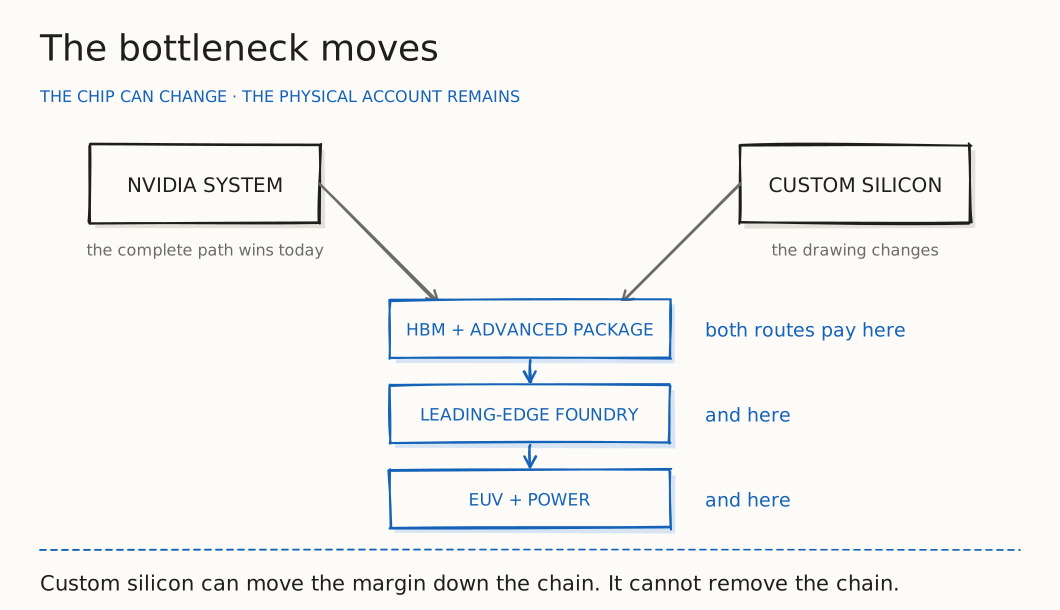
That is the argument:
In a race to build, the best place to stand is the required step that the fewest companies can supply.
The model company has to be right about the model, the product, the price and the user. The supplier underneath it can sell to the company that guessed right and the company that guessed wrong, at least until one stops ordering.
The applications are fighting for the user. The infrastructure companies are selling the fight.
Do not ask which chatbot won the week.
Ask which bill every chatbot still had to pay.